
Exeter Strimming Services
Banks, verges, paddocks and field edges
The ground a mower cannot get to: steep hedgebanks, roadside verges, paddock and field margins, hedge bases, fence lines and the awkward strip round the edge.
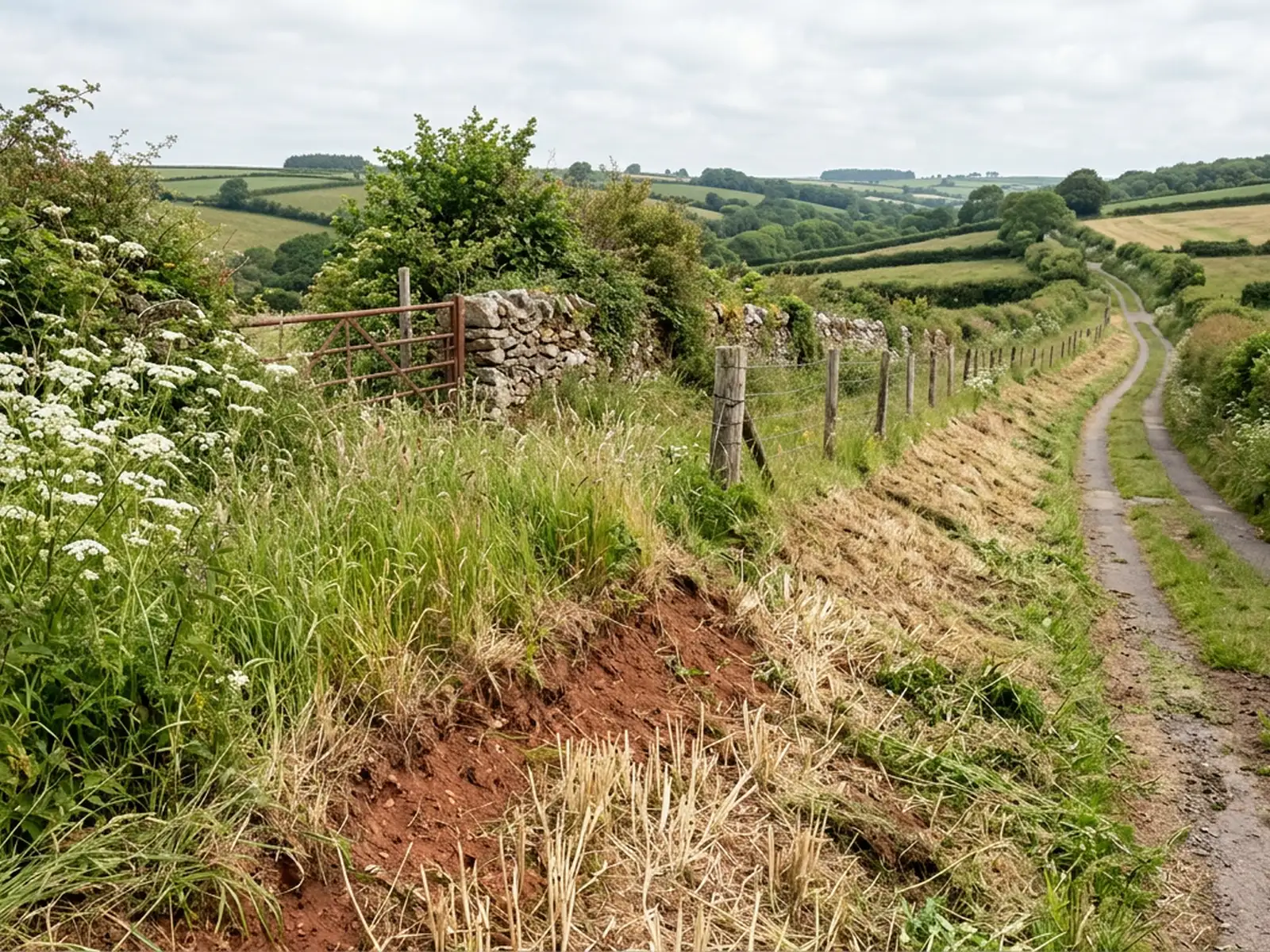
This is the work that keeps coming back on smallholdings, paddocks and any property with a length of Devon hedgebank on it. The middle of a field gets topped or grazed. The edges do not, and within two seasons the usable ground has shrunk by a metre all the way round.
A harness mounted brush cutter is the right tool for it because it can be worked at any angle. A bank at forty five degrees, a verge that drops away into a ditch, the strip behind a stable block that a quad topper cannot turn in: all of it cuts, it just takes longer than flat ground does.
Most people book this by the half day or the day rather than by the hour, because the work is a length rather than a plot and it is easier to say how much of the boundary gets done in a day than to guess an area.
What is included
- Steep hedgebanks cut back to the face, top and sides
- Roadside verges and lane edges cut back to the boundary line
- Paddock and field margins taken back to recover the grazing
- Around stable blocks, field shelters, water troughs and gateways
- Hedge bases and fence lines strimmed out so the wire is visible again
- Around obstacles a topper cannot reach: posts, trees, hydrants, poles and inspection covers
Why the edges go first
Devon hedgebanks are earth and stone banks with a hedge on top, and the bank face grows as hard as anything on the property. It carries cow parsley, bramble, nettle and, by late summer, whatever has seeded out of the hedge itself. Nothing on a farm is designed to cut it: a topper cannot reach the face, a flail needs a tractor and room to work, and hand tools take a day per length.
The result is that the bank face and the metre in front of it are the first ground lost on almost every paddock in the county. Recovering it is one of the quickest wins there is, and on a rented paddock it is often the difference between the grazing being worth the rent and not.
Verges, sightlines and who owns what
Roadside verges outside a property are a common ask, usually because a hedge or a bank has grown out far enough to block the view pulling out of a drive. Cutting your own frontage back to the boundary is straightforward and takes very little time.
Beyond your boundary the verge normally belongs to the highway authority, and the cutting of it is theirs to schedule. Frontage gets cut back to the line, and anything past it is left, which is the correct answer rather than the convenient one.
Doing it once a year, or twice
A boundary cut once, in late summer after the birds have finished nesting, stays presentable through the winter and is the usual pattern. Cut twice, in June and again in September, it stays usable all season and the second cut is quicker and cheaper than the first because there is less to take.
Nesting is worth planning around. Between March and August there are birds in Devon hedges, and cutting a hedge base in that window is something to avoid where it can be avoided. Bank faces and open verge are a different matter, and the standing grass in a paddock is not a hedge.
On the day
How a banks and paddocks runs
- Step 1
Measure it in metres run
For banks and boundaries a length is more use than an area. Pace it or read it off a map, and say how tall the growth is on it.
- Step 2
Say what the ground is doing
A slope, a ditch, wet ground, loose stone in the bank face and anything that has been dumped in it over the years all change the pace.
- Step 3
Book time, not a task
Half a day is £240 and a full day is £480, and it is usually clearer to agree how much gets done in that time than to try to fix a price on a boundary nobody has walked.
- Step 4
Livestock and access
Stock has to be off the ground being cut. Gates, tracks and where the trailer can turn all need saying beforehand rather than on the morning.
- Step 5
Cut and clear
Bank arisings are usually left to rot down where they fall, which is normal practice and saves you the tipping cost. Say if you want them off.
Behind the work
Kit, cover and registration
Registered waste carrier
Hembury Contracting holds waste carrier registration CBDU641882, so the cut material can leave your property legally rather than being someone else's problem. Tipping is charged on at cost.
Public liability insurance
Cover is in place for the work. Brush cutters throw stones, and anyone taking one near your glass, your car or your neighbour's fence should be able to say what happens if one goes the wrong way.
Petrol brush cutters, not a domestic strimmer
Harness mounted machines with a metal blade for woody bramble and bracken and a nylon head for grass and edges. A hired garden strimmer will bog down in the first hour of anything that has stood for a season.
One rate, published
£60 an hour including VAT, two hour minimum. There is no free site visit to sit through, no per job quote to wait for and nothing to negotiate. What it costs depends on how long it takes.
Banks and paddocks
Banks, verges, paddocks and field edges questions
How much bank can you cut in a day?
On a bank of ordinary summer growth, a few hundred metres of one face in a day is a fair expectation. Woody bramble along the whole length brings that down sharply, and a slope you have to work across rather than along brings it down again.
Do you take paddock arisings away?
Only if you want them gone. On bank and field edge work they are normally left to rot down where they fall, which costs nothing and is what most people ask for. Removal is charged at whatever the tip charges for the load.
Can you work around horses?
The stock needs to be off the ground being cut, in another paddock or stabled. A brush cutter is loud and throws material, and no amount of care makes it safe to work alongside a curious horse.
Where
Banks, verges, paddocks and field edges across the South West
See the hourly rate
Book a clearance with Exeter Strimming Services
Send a postcode, a rough size and a couple of photographs. Sam Hembury will come back with an estimate in hours and the next dates available.